The best temples in Thailand are the Grand Palace and Wat Pho in Bangkok, Wat Arun on the river, Wat Rong Khun near Chiang Rai and Wat Phra That Doi Suthep above Chiang Mai, plus the old ruins at Ayutthaya and Sukhothai. Entry runs from free to 500 THB, and a dress code applies.
Last updated: October 2026. Fees are in Thai baht (THB) with rough rupee figures alongside, worked at about 2.6 rupees to a baht. Temple fees change often, so treat these as a guide and check on the day.
Table of Contents
- What are the best temples in Thailand?
- Bangkok's temples: Grand Palace, Wat Pho and Wat Arun
- What should you wear to a Thai temple?
- Temples in Chiang Mai and the north
- What are the best temple ruins to visit?
- How many temples should you visit, and in what order?
- What do Indian travellers need to know?
- What to watch out for at Thai temples
- Thailand's Temples at a Glance: Key Places and Terms
- FAQs
What are the best temples in Thailand?
The best temples in Thailand split into three groups: the grand working temples of Bangkok, the hillside and art temples of the north, and the ruined temple cities of the old kingdoms. Most charge a foreigner entry fee, and the big Bangkok ones enforce a dress code at the gate.
A temple in Thai is a wat, and the country has tens of thousands of them. You do not need to see many. A handful, picked across the styles, gives you the gold and glass of a royal temple, the calm of a northern hill wat and the weathered brick of a 600 year old ruin. Here is what the headline temples cost and when they open.
| Temple | City | Foreigner fee | Opening hours |
|---|---|---|---|
| Grand Palace & Wat Phra Kaew | Bangkok | 500 THB (~1,300 rupees) | 08:30 to 15:30 (tickets) |
| Wat Pho (Reclining Buddha) | Bangkok | 300 THB (~780 rupees) | 08:00 to 18:30 |
| Wat Arun (Temple of Dawn) | Bangkok | 200 THB (~520 rupees) | 08:30 to 18:00 |
| Wat Saket (Golden Mount) | Bangkok | 100 THB (~260 rupees) | 07:30 to 19:00 |
| Wat Rong Khun (White Temple) | Chiang Rai | 200 THB (~520 rupees) | 08:00 to 17:00 |
| Wat Phra That Doi Suthep | Chiang Mai | ~50 THB (~130 rupees) | 06:00 to 18:00 |
| Ayutthaya temples (per site) | Ayutthaya | ~50 THB (~130 rupees) | 08:00 to 18:00 |
All fees are for foreign visitors as of October 2026. Wat Rong Khun raised its foreigner fee to 200 THB on 1 January 2026. Thai nationals enter most temples for free.
Bangkok's temples: Grand Palace, Wat Pho and Wat Arun
Bangkok's three big temples sit within walking and short-ferry distance of each other along the Chao Phraya river, and most visitors do all three in one morning. Start early, because the Grand Palace gets hot and crowded by mid-morning.
Grand Palace and Wat Phra Kaew
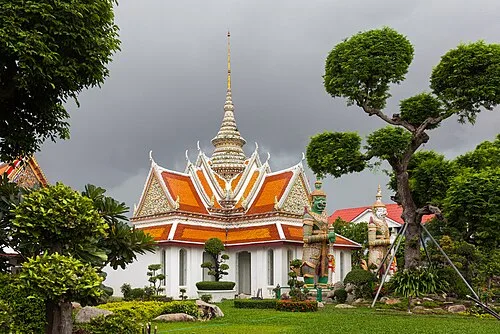
You step through the gate into a courtyard of gold spires and mirrored mosaic, the Emerald Buddha sitting small and high in its hall, guards in old uniforms at the corners. The Grand Palace was the royal residence for 150 years, and Wat Phra Kaew inside it is Thailand's most sacred temple. Entry is 500 THB, tickets sell from 08:30 to 15:30, and the dress code is the strictest in the country. The painted gallery around the courtyard tells the Ramakien, the Thai version of the Ramayana, which many Indian visitors recognise scene by scene.
Wat Pho and the Reclining Buddha
A ten minute walk south brings you to Wat Pho and its 46 metre gold Reclining Buddha, so long you shuffle past it in sections, the soles of its feet inlaid with mother of pearl. Wat Pho is also the home of traditional Thai massage, and you can take a cheap massage at the school on site. Entry is 300 THB and includes a bottle of water. It is open 08:00 to 18:30.
Wat Arun across the river
A 5 THB cross-river ferry from Tha Tien pier drops you at Wat Arun, the Temple of Dawn, its tall central prang covered in broken porcelain that catches the light. You can climb the steep lower steps for a view back over the river. Entry is 200 THB, open 08:30 to 18:00, and it looks its best in late afternoon or lit up after dark.
These three anchor any Bangkok trip. For the wider list, see our guide to places to visit in Bangkok, and to have the temple run, transfers and a guide arranged, our Bangkok tour packages cover it.
What should you wear to a Thai temple?
Cover your shoulders and your knees, and take your shoes off where signs ask. This applies to men and women, and the Grand Palace turns away anyone dressed wrong at the gate, so it is the rule to plan around.
- Shoulders covered: no vests, singlets or sleeveless tops. A T-shirt is fine.
- Knees covered: no shorts or short skirts. Long trousers, a long skirt or a sarong work.
- Feet: remove shoes before entering any temple building. Slip-ons save time.
- Avoid see-through or tight clothing, and do not wear a top with a Buddha image on it.
Carry a light scarf or buy a cheap sarong, around 100 to 200 THB from any market, and you are covered for every temple. The Grand Palace has a booth that lends cover-ups against a deposit, but the queue is long, so come dressed right.
Do not pose with your back to a Buddha image, climb on statues, or point your feet at a Buddha or a monk, which is rude in Thai culture. Women should not touch or hand anything directly to a monk. Photography is usually fine in courtyards but banned inside some shrine halls, such as the Emerald Buddha hall, where signs are clear.
Temples in Chiang Mai and the north
The north has a softer, quieter temple scene than Bangkok, set in hills and old city walls. Chiang Mai alone has hundreds, and nearby Chiang Rai holds the two most photographed modern temples in the country.
Wat Phra That Doi Suthep
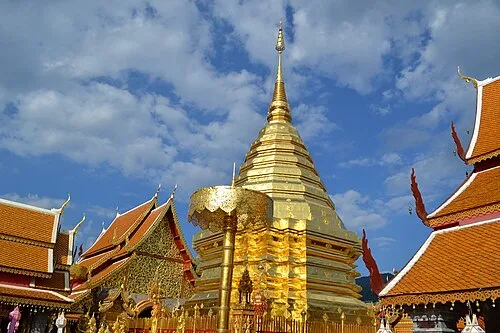
A road winds up the mountain west of Chiang Mai to Doi Suthep, where a 306 step naga staircase, or a small funicular, leads to a golden chedi and a view over the whole city. It is the north's most important temple. Foreign entry is around 50 THB, and it opens early, from about 06:00. Go at opening or late afternoon to miss the coach groups.
Wat Chedi Luang and the old city
In the centre of Chiang Mai's walled old town, Wat Chedi Luang is a huge partly collapsed brick chedi from the 1400s, with a daily monk chat where you can ask questions of young monks practising their English. A small fee of around 50 THB applies.
Wat Rong Khun, the White Temple
About three hours northeast in Chiang Rai, Wat Rong Khun is a brilliant white, mirror-flecked temple built by a Thai artist, with a bridge over reaching hands and murals that mix Buddhist imagery with modern pop culture. It is a contemporary art piece, not an ancient site. Foreign entry rose to 200 THB on 1 January 2026, and it is open roughly 08:00 to 17:00.
If the north is your focus, our Chiang Mai tour packages string Doi Suthep, the old city and a Chiang Rai day trip into one route.
What are the best temple ruins to visit?
The best temple ruins are at Ayutthaya, an hour from Bangkok, and Sukhothai in the lower north. Both are UNESCO sites and former capitals, where you walk among roofless brick temples and seated Buddhas rather than working shrines.
Ayutthaya is the easy one, reachable by train, minivan or a river cruise from Bangkok in about 1.5 to 2 hours. Its famous image is the stone Buddha head wrapped in tree roots at Wat Mahathat. Most individual temples charge around 50 THB, or you can buy a combined pass. Sukhothai, about 400 km north of Bangkok, is older and greener, its central zone best seen by rented bicycle, with a foreigner fee of around 100 THB per zone.
Ruins reward restraint. Ayutthaya in the midday heat, rushed in two hours off a bus, is a letdown. Rent a bicycle or hire a driver, go early or late, carry water, and the same site becomes the quiet highlight of a trip.
How many temples should you visit, and in what order?
Two to four temples is enough for most trips before they blur together. Spread them across styles and days rather than stacking six into one morning, which is the fast route to temple fatigue.
In Bangkok, do the big three in one early morning in this order: Grand Palace first at opening, Wat Pho next on foot, then the ferry to Wat Arun, finishing before the afternoon heat. Keep a second temple day for the north, where Doi Suthep and the old city pair naturally. If you are visiting ruins, give Ayutthaya its own half or full day rather than bolting it onto a city tour.
What do Indian travellers need to know?
Indian travellers get visa-free entry for short stays, reach Bangkok in about four hours, and will recognise a lot of the religious story on the temple walls. The practical entry details are below.
As of October 2026, Indian passport holders enter Thailand visa-free for 30 days for tourism, cut from 60 days on 15 September 2026. You also have to file the free Thailand Digital Arrival Card (TDAC) online within three days before you land, at tdac.immigration.go.th
- The Buddhist link: Buddhism travelled to Thailand from India, and the Grand Palace murals retell the Ramayana as the Ramakien, so much of the imagery is familiar.
- Food near temples: the Bangkok old town and Chiang Mai have vegetarian and Indian food within easy reach of the main temples.
- Shoes and socks: you remove shoes often, so wear slip-ons and carry socks for hot tile floors in the midday sun.
- Timing: temples are busiest and hottest from late morning. Early starts are cooler, quieter and better for photos.
For the full entry breakdown see our Thailand visa guide for Indians, and for how temples fit the wider trip, our guide to what Thailand is famous for sets the scene.
What to watch out for at Thai temples
The main risks at temples are not the temples themselves but the scams run outside them, plus a few etiquette slips. Knowing the common ones keeps your morning smooth.
The items below are the ones that catch Indian visitors most often.
- The "temple is closed today" scam: a friendly stranger or tuk-tuk driver near the Grand Palace says it is shut for a holiday or a ceremony and offers a cheap tour elsewhere, which ends at gem and tailor shops paying him commission. The Grand Palace is open daily. Walk to the official gate and check yourself.
- Tuk-tuk gem run: the 10 THB all-day tuk-tuk tour is bait for the same commission shops. Agree no detours, or take a metered taxi or the Grab app.
- Fake monks: people in robes outside tourist sites handing out trinkets and asking for a donation are not real monks, who do not solicit money on the street.
- Photography rules: courtyards are fine, but some shrine halls ban photos, most strictly the Emerald Buddha hall. Follow the signs and the staff.
- Dress enforcement: the Grand Palace is strict at the gate, so arriving in shorts means a long cover-up queue or a wasted trip. Come covered.
Thailand's Temples at a Glance: Key Places and Terms
These are the names and terms that come up most when planning a temple trip in Thailand.
- Wat: the Thai word for a Buddhist temple or monastery.
- Grand Palace and Wat Phra Kaew: Bangkok's royal temple complex and home of the Emerald Buddha, the country's most sacred image.
- Wat Pho: the Bangkok temple of the giant Reclining Buddha and the home of traditional Thai massage.
- Wat Arun: the riverside Temple of Dawn, known for its porcelain-covered central prang.
- Wat Rong Khun (White Temple): a modern all-white art temple near Chiang Rai, built by artist Chalermchai Kositpipat.
- Wat Phra That Doi Suthep: the gold hilltop temple above Chiang Mai, the north's most important shrine.
- Ayutthaya: a former Thai capital an hour from Bangkok, now a UNESCO park of temple ruins.
- Sukhothai: an older capital in the lower north, a UNESCO park best explored by bicycle.
- Chedi: the bell-shaped spire, also called a stupa, that holds relics at a Thai temple.
- Ramakien: the Thai retelling of the Ramayana, painted around the Grand Palace gallery.
FAQs
The Grand Palace with Wat Phra Kaew in Bangkok is the most famous and most sacred home of the Emerald Buddha. Wat Pho with its giant Reclining Buddha and Wat Arun on the river are close behind. In the north, Wat Phra That Doi Suthep and the White Temple near Chiang Rai are the best known.
Foreigner entry runs from free to 500 THB. The Grand Palace is 500 THB (about 1,300 rupees), Wat Pho 300 THB, Wat Arun 200 THB, and the White Temple 200 THB from January 2026. Northern hill temples and Ayutthaya ruins are around 50 THB each. Many smaller local temples are free.
Cover your shoulders and knees, and remove your shoes before entering temple buildings. No vests, shorts, short skirts or see-through clothing. The Grand Palace enforces this strictly at the gate. Carry a scarf or a cheap sarong and you are covered for every temple you visit.
Two to four across the trip is plenty for most people before they start to look alike. Do Bangkok's Grand Palace, Wat Pho and Wat Arun in one early morning, then save a northern temple day or an Ayutthaya ruins day for later. Spreading them out beats cramming.
Early morning, from opening until about 10am. It is cooler, far less crowded, and the light is best for photos. The Grand Palace and Doi Suthep in particular fill with coach groups by mid-morning. Late afternoon is the next best window, and Wat Arun looks its best then.
Yes. Ayutthaya is about 1.5 to 2 hours from Bangkok by train, minivan or river cruise, and a half to full day covers the main temples such as Wat Mahathat. Go early or late to avoid the midday heat, and rent a bicycle or hire a driver to get between the sites comfortably.