Scuba Diving in Thailand: Where, When and What It Costs
Scuba diving in Thailand runs across two coasts with opposite seasons. The Andaman side, Phuket, the Similan Islands and Richelieu Rock, dives best from November to April, while the Gulf around Koh Tao stays diveable most of the year. A fun dive costs from about 800 baht, an Open Water course from 11,000 baht.
Thailand scuba diving at a glance
Use this quick reference before you read the detail below.
- Two coasts: the Andaman Sea on the west, the Gulf of Thailand on the east, with opposite rainy seasons.
- Best overall window: November to April, when both coasts are usually calm and clear.
- Water temperature: 26 to 30 degrees Celsius year-round, so a 3mm wetsuit or a shorty is enough.
- Visibility: 10 to 30 metres on a good day, best at the offshore Andaman sites.
- Headline sites: Richelieu Rock, the Similan Islands, Hin Daeng, Sail Rock and the HTMS Sattakut wreck.
- Certification: PADI and SSI are the common agencies; you do not need any certificate for a one-off try dive.
- Cost band: roughly 800 to 30,900 baht depending on whether you do a single dive, a course or a liveaboard.
Table of Contents
- Which coast should you dive, the Andaman or the Gulf?
- Where are the best places to scuba dive in Thailand?
- How much does scuba diving in Thailand cost?
- What types of scuba diving can you do in Thailand?
- When is the best time to scuba dive in Thailand?
- How do you get certified to dive in Thailand?
- What should Indian travellers know before diving?
- Key Thailand scuba diving terms
- FAQs
Which coast should you dive, the Andaman or the Gulf?
Pick the coast by your travel dates first and your wishlist second, because the two coasts are good at opposite times of year.
The Andaman Sea on the west gives Thailand's best diving: offshore pinnacles, manta rays and whale sharks at the Similans, Richelieu Rock and Hin Daeng. Its season is roughly November to April. The two marine national parks, Similan and Surin, shut completely from mid-May to mid-October, so a monsoon-season trip rules them out.
The Gulf of Thailand on the east is gentler and cheaper. Koh Tao trains more divers than almost anywhere on earth, and the Gulf keeps diving most of the year. Its weakest stretch is late October to December, when the northeast monsoon brings rain and drops visibility. If you travel in the July to September window, the Gulf is usually the better bet while the Andaman sits in its wet season.
| Coast | Best months | Weakest months | Known for | Main gateways |
|---|---|---|---|---|
| Andaman (west) | Nov to Apr | May to Oct (parks shut mid-May to mid-Oct) | Manta rays, whale sharks, pinnacles, liveaboards | Phuket (HKT), Khao Lak, Krabi (KBV) |
| Gulf (east) | Most of the year; clearest Mar to Sep | Late Oct to Dec (monsoon) | Cheap courses, wrecks, easy reefs | Koh Samui (USM), Chumphon, Surat Thani |
If your only free dates are the summer holidays or Diwali in October, lean towards the Gulf and Koh Tao. The Similans and Surin are closed then, and the open Andaman day-trip sites can be rough.
Where are the best places to scuba dive in Thailand?
Thailand's dive spots split neatly between the two coasts. The destinations below run roughly from the Andaman in the west to the Gulf in the east, with what each is known for and who it suits.
| Destination | Coast | Best months | Nearest airport | Known for | Suits |
|---|---|---|---|---|---|
| Phuket | Andaman | Nov to Apr | Phuket (HKT) | Day trips, wrecks, liveaboard launch point | All levels |
| Similan Islands | Andaman | Mid-Oct to mid-May | Phuket (HKT) / Khao Lak | Granite boulders, mantas, whale sharks | Beginner to advanced |
| Richelieu Rock & Surin | Andaman | Jan to Apr | Phuket (HKT) / Khao Lak | Thailand's top site, whale sharks | Intermediate to advanced |
| Koh Phi Phi & Krabi | Andaman | Nov to Apr | Krabi (KBV) / Phuket (HKT) | Leopard sharks, turtles, easy reefs | Beginner friendly |
| Koh Lanta (Hin Daeng/Muang) | Andaman | Nov to Apr | Krabi (KBV) | Deep walls, mantas, big fish | Advanced |
| Koh Tao | Gulf | Year-round; best Mar to Sep | Koh Samui (USM) then boat | Cheap courses, turtles, Sail Rock | Beginners, course takers |
| Koh Samui | Gulf | Year-round; best Mar to Sep | Koh Samui (USM) | Sail Rock day trips, comfort base | All levels |
| Pattaya | Gulf | Year-round | Bangkok (BKK/DMK) | Wreck diving near Bangkok | Wreck and weekend divers |
| Koh Lipe | Andaman (far south) | Nov to Apr | Hat Yai then boat | Quiet reefs, Eight Mile Rock | All levels |
Phuket (HKT)
Phuket is the easiest place to start, with the most dive shops and direct flights from several Indian cities. Local day boats run to Shark Point, famous for leopard sharks, the King Cruiser wreck, which sank in 1997 and sits at 12 to 30 metres, and Koh Doc Mai. Phuket is also where most Similan and Richelieu liveaboards depart. The reef season is November to April.
If you are building a wider trip around your dives, our Phuket tour packages pair diving days with island hopping and transfers.
Similan Islands
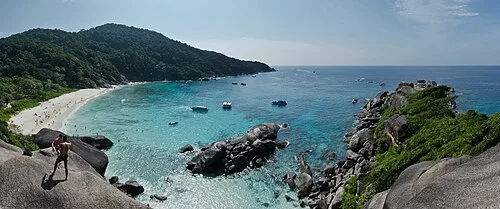
The Similans are the postcard of Thai diving: smooth granite boulders, swim-throughs and the chance of manta rays and whale sharks at Koh Bon and Koh Tachai. You reach them by liveaboard or a long speedboat day trip from Khao Lak or Phuket. The catch is access. The park opens around 15 October and closes around 15 May each year, and the foreigner entry fee is 500 baht for adults, confirmed each season by the Department of National Parks.
Richelieu Rock & Surin Islands
Richelieu Rock, a horseshoe-shaped pinnacle in the far north Andaman, is widely rated Thailand's single best dive. Purple soft coral covers the rock, schools of barracuda and trevally circle it, and February to April is the strongest window for whale sharks. It is liveaboard territory, usually combined with the nearby Surin Islands, which share the Similan park season and the 500 baht fee.
Koh Phi Phi & Krabi
The Phi Phi sites, Bida Nok and Bida Nai, are shallow, sheltered and full of leopard sharks, turtles and soft coral, which makes them ideal for a first open-water experience. Day boats run from Phuket, Phi Phi, Krabi and Koh Lanta. A marine park fee applies at Phi Phi and is often not included in the dive price, so ask.
Krabi also makes a relaxed, longtail-boat base for diving; see our Krabi tour packages if you want to stay on that side.
Koh Lanta: Hin Daeng and Hin Muang
Hin Daeng, or Red Rock, and Hin Muang, Purple Rock, are two offshore pinnacles that drop into deep blue water. They draw manta rays, reef sharks and the occasional whale shark, and the wall at Hin Muang falls past 50 metres. Currents can be strong and there is no shallow reef to hide behind, so these are advanced dives, best from November to April.
Koh Tao
Koh Tao certifies a huge share of the world's new divers, and for good reason: calm bays, shallow reefs and the lowest course prices in Thailand. Sites include Chumphon Pinnacle, the HTMS Sattakut wreck sunk as an artificial reef, and Sail Rock, shared with Koh Phangan and Koh Samui, where whale sharks turn up most often from March to May and again around September. Diving runs year-round, with late October to December the wettest patch.
Koh Samui (USM) and Sail Rock
Koh Samui has its own airport and a comfortable range of hotels, which makes it the softer Gulf base for divers who want resorts over backpacker bungalows. Most diving is a day trip out to Sail Rock. The Gulf dives all year, and March to September is the clearest stretch.
For a resort-style Gulf trip with dives added on, look at our Koh Samui tour packages.
Pattaya
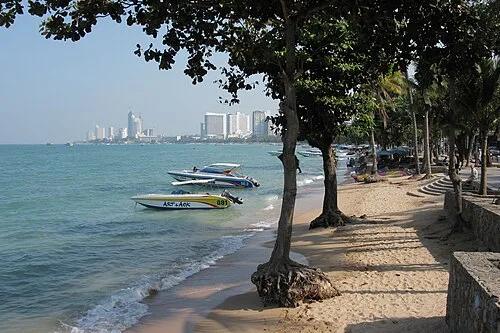
Pattaya is the pick if you are short on time and based near Bangkok, about two hours away. It is Thailand's main wreck-diving area, with several sunken naval ships at around 30 metres. Visibility is lower than the islands, but it dives all year and needs no internal flight.
Koh Lipe
Koh Lipe sits in the far south Andaman near the Malaysian border, reached via Hat Yai and a boat. The reefs are quieter and the standout site is Eight Mile Rock, a pinnacle that pulls in bigger fish. The season matches the rest of the Andaman, November to April.
How much does scuba diving in Thailand cost?
Costs depend on what you do, where you do it and how many dives you book. Koh Tao is the cheapest place to learn and to fun dive; Andaman liveaboards to the Similans and Richelieu Rock are the priciest. The prices below are per person as of October 2026, and vary by operator, so treat them as a starting point.
| Activity | What it is | Price from (THB) | Approx INR |
|---|---|---|---|
| Discover Scuba / try dive | One guided dive, no certificate needed | 2,600 | 7,500 |
| Single fun dive (certified) | One dive, Koh Tao rate with gear | 800 to 1,200 | 2,300 to 3,500 |
| 10-dive fun package (Koh Tao) | Ten dives over several days | 7,000 to 10,000 | 20,000 to 29,000 |
| Phuket day trip, 2 dives | Certified diver, local Andaman sites | 3,000 | 8,700 |
| PADI Open Water course | Beginner certification, 3 to 4 days | 11,000 to 12,900 | 32,000 to 37,000 |
| PADI Advanced Open Water | 5 dives, 1.5 to 2 days | 11,000 | 32,000 |
| Similan liveaboard 4D/3N | 10 dives, Similans and Richelieu Rock | 17,900 to 20,400 | 52,000 to 59,000 |
| Similan liveaboard 6D/5N | 18 dives, Similans, Surin, Richelieu | 26,200 to 30,900 | 76,000 to 89,000 |
Two costs are easy to forget. National marine park fees are usually charged on top: 500 baht per adult and 250 baht per child aged 3 to 14 at the Similan and Surin parks, and a separate fee at Phi Phi. Liveaboards add these as a lump sum, around 1,600 baht for a 4-day Similan trip and 2,000 baht for a 6-day trip. Equipment rental is included in most course and day-trip prices, but confirm it rather than assume.
Rupee figures use roughly 1 baht to 2.9 rupees and are rounded. The rate moves, so check a live converter and carry some baht in cash, as several island dive shops do not take cards..
What types of scuba diving can you do in Thailand?
Thailand covers the full range, from a first supervised dive to technical wreck penetration. Here is what each type means and who it suits.
| Type | What it is | Certification needed | Where it is strong |
|---|---|---|---|
| Try dive (Discover Scuba) | One shallow dive with an instructor | None | Koh Tao, Phi Phi, Phuket |
| Open Water course | Your first full certificate, to 18m | None to start | Koh Tao, Koh Lanta, Phuket |
| Fun diving | Guided dives once you are certified | Open Water | Everywhere |
| Liveaboard diving | Multi-day boat trips to remote sites | Open Water, some sites Advanced | Similans, Surin, Richelieu Rock |
| Wreck diving | Dives on sunken ships | Advanced recommended | Pattaya, Koh Tao, Phuket (King Cruiser) |
| Drift and deep diving | Current and depth beyond 18m | Advanced | Hin Daeng, Richelieu Rock, Koh Lanta |
| Night diving | Guided dives after dark | Open Water plus | Koh Tao, Phi Phi |
Most first-time Indian visitors do either a try dive or an Open Water course. If you only want to see a reef once, the try dive is enough and needs no swimming test on paper. If you expect to dive again on later trips, the Open Water certificate is lifetime and pays for itself within a few holidays.
When is the best time to scuba dive in Thailand?
November to April is the safe answer for the country as a whole, because both coasts are usually calm then. The detail matters if you are chasing big animals or travelling in the off months.
| Months | Andaman (west) | Gulf (east) | Highlights |
|---|---|---|---|
| Nov to Feb | Excellent, calm and clear | Fair, some monsoon rain into Dec | Peak Andaman reef season |
| Mar to Apr | Excellent, warmest water | Very good, clear | Best whale shark and manta window at Richelieu Rock |
| May to Jun | Declining; parks shut mid-May | Good | Gulf takes over as Andaman closes |
| Jul to Sep | Poor, wet and rough | Best of the year for Koh Tao | Dive the Gulf, not the Andaman |
| Oct | Opening mid-month, variable | Wettest in the Gulf | Transition month, book flexibly |
For whale sharks and mantas, aim at Richelieu Rock and the Similans between February and April. Sightings are never guaranteed, so book for the diving itself and treat a big animal as a bonus. For the Gulf, the clearest water is usually March to September, which is the opposite of what many first-timers expect.
Boat trips are weather-dependent. In the monsoon months, speedboat day trips to exposed Andaman sites are cancelled at short notice. Build a spare day into your plan, or dive the sheltered Gulf instead, so a single rough morning does not cost you your only dive.
How do you get certified to dive in Thailand?
Certification is straightforward and Thailand is one of the cheapest places on earth to do it. The Open Water course is the standard entry certificate.
- Pick an agency. PADI and SSI are the most common, and both certificates are recognised worldwide. The course content is near identical.
- Choose a base. Koh Tao is the budget and social choice; Koh Lanta and Phuket are calmer and less crowded.
- Allow 3 to 4 days for the Open Water course: theory and pool skills first, then four open-water dives.
- Meet the basics: you must be at least 10 years old, able to swim, and reasonably healthy.
- Complete a medical declaration. If you tick yes to any condition, you need a doctor's sign-off before you can dive.
After Open Water you can dive to 18 metres with a buddy. The Advanced course adds deep and navigation dives and opens sites like Hin Daeng and Richelieu Rock. If you are nervous about committing, do a try dive first and roll the fee into the full course at many shops.
What should Indian travellers know before diving?
A few things catch first-time divers out, and some of them are safety issues rather than nice-to-know points. Read these before you book.
- Do not fly too soon after diving. Finish your last dive at least 24 hours before your flight home, especially after several dives or a liveaboard. Plan a non-diving day at the end rather than diving on your departure morning.
- Know where the recompression chamber is. Chambers operate on Koh Tao and in the Phuket and Krabi area, but remote sites like the Similans are hours away by boat. Dive conservatively there.
- Buy dive insurance. Ordinary travel insurance often excludes scuba. A DAN or dive-specific policy covers chamber treatment and evacuation, which can be very expensive otherwise.
- Choose the operator, not the cheapest price. Koh Tao's low rates come with crowded boats at popular sites. Paying 20 to 30 percent more for a small-group operator with good reviews is worth it for safety and for actually seeing the reef.
- Fill the medical form honestly. Hiding asthma, heart issues or recent surgery to avoid a doctor's visit is how holidays turn into emergencies underwater.
- Do not touch the reef or chase the wildlife. Standing on coral, holding turtles or crowding a whale shark harms the animal and can get an operator fined. Pick shops that brief a no-touch, no-feeding policy.
- Use reef-safe sunscreen. Sunscreens with oxybenzone are banned in Thailand's marine national parks. Carry a mineral, reef-safe one, or cover up with a rash guard instead.
- Never dive impaired. Diving hungover, or after cannabis, is dangerous. Note that recreational cannabis is no longer legal in Thailand as of 2025, and buying it without a Thai medical prescription carries fines and possible jail.
Do Indians need a visa to dive in Thailand?
No visa is needed for a normal dive holiday. Indian passport holders enter Thailand visa-free for up to 30 days for tourism, a rule effective 15 September 2026 that replaced the earlier 60-day exemption. Longer stays need a Thai e-Visa. Every arrival must file the free Thailand Digital Arrival Card (TDAC) online within 72 hours before landing, at tdac.immigration.go.th. Carry a passport valid for at least six months. Entry rules have changed several times recently, so confirm close to your travel date.
New to the Thai islands? Our guide to the islands in Thailand explains how each island links to the others and when to visit, which helps you slot diving into a wider trip.
Key Thailand scuba diving terms
Short definitions of the named places and terms used above.
- Richelieu Rock: a submerged pinnacle in the north of Andaman, rated Thailand's best dive and a whale shark hotspot from February to April.
- Similan Islands: an Andaman marine national park of granite-boulder dive sites, open roughly mid-October to mid-May only.
- Surin Islands: an Andaman national park near the Myanmar border, usually dived by liveaboard alongside Richelieu Rock.
- Koh Tao: a small Gulf island that is one of the world's largest and cheapest scuba certification centres.
- Sail Rock: a Gulf pinnacle between Koh Tao, Koh Phangan and Koh Samui, known for its vertical swim-through and whale sharks.
- Hin Daeng and Hin Muang: two deep offshore pinnacles off Koh Lanta, advanced sites for manta rays and big fish.
- King Cruiser: a passenger ferry that sank near Phuket in 1997 and is now a popular wreck dive at 12 to 30 metres.
- HTMS Sattakut: a decommissioned Thai navy ship sunk off Koh Tao as an artificial reef and wreck-diving site.
- Liveaboard: a dive boat you sleep on for several days to reach remote sites like the Similans and Surin.
- TDAC: the Thailand Digital Arrival Card, a free online entry form every visitor must file before arrival.
FAQs
Yes, for most healthy people. Thailand has calm, shallow training bays and strict certification standards through PADI and SSI. The real risks are a dishonest medical form and a poor operator, not the diving itself. Complete the medical declaration truthfully, pick a well-reviewed shop with small groups, and start with a try dive or an Open Water course rather than an advanced site.
For the single best dive, Richelieu Rock in the north Andaman is the usual answer, reached by liveaboard. For the best beginner experience, Koh Tao in the Gulf and Koh Phi Phi on the Andaman are hard to beat. The Similan Islands give the most dramatic scenery. Your best choice depends on your travel dates, since the two coasts peak at opposite times.
A try dive starts around 2,600 baht, roughly 7,500 rupees. An Open Water certification runs 11,000 to 12,900 baht, about 32,000 to 37,000 rupees. Certified fun dives on Koh Tao start near 800 baht each. A four-day Similan liveaboard is the big spend, from about 17,900 baht per person before park fees. Prices are as of October 2026 and vary by operator.
November to April is best for the country overall, and it is the only window for the Similan and Surin parks, which shut from mid-May to mid-October. February to April is the strongest window for whale sharks and mantas. If you can only travel from July to September, dive the Gulf around Koh Tao and Koh Samui, which is at its clearest then while the Andaman is in its wet season.
For a one-off try dive, no formal test applies, but basic water confidence makes it far more enjoyable, and an instructor stays with you throughout. For the Open Water certification you must be able to swim and float, since the course includes a short swim and a survival-float. If you cannot swim at all, start with a pool-based try dive and build comfort first.
Koh Tao is cheaper, more social and set up almost entirely around courses, which suits budget and solo travellers. Phuket costs a little more but has an airport with direct flights from India, better hotels and easier logistics for families. If price and a backpacker scene appeal, choose Koh Tao. If convenience and comfort matter more, choose Phuket.
Children can start young: the PADI Bubblemaker programme suits ages 8 and up in shallow water, and the full Open Water course is open from age 10. Non-swimmers and nervous first-timers should book a Discover Scuba try dive, where an instructor controls the dive and depth is limited. Always declare any medical condition for the child or adult before booking.
You will very likely see harmless reef species such as leopard sharks and blacktip reef sharks, especially at Shark Point and Phi Phi. Whale sharks, the gentle giants, are seasonal and never guaranteed; your best odds are Richelieu Rock and the Similans from February to April. Book the trip for the diving overall and treat a whale shark as a lucky bonus.